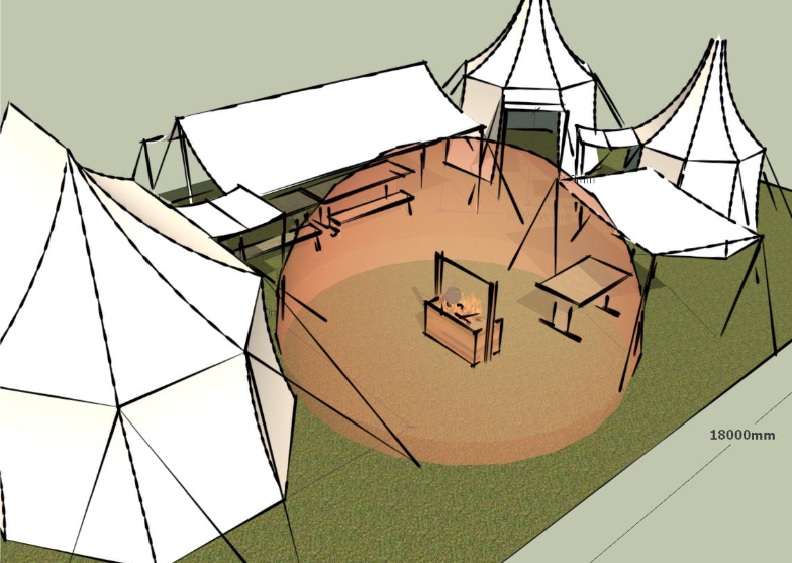
Camp planning is done with the risk of fire in mind. Therefore, fire lanes are laid out between the different quarters, and each quarter is limited in size. It is important that these fire lanes are kept free of tents and equipment. A fire truck must be able to pass on its way further into the camp, and the lanes are therefore 4 m wide. This is done for your protection, and the safety of those around you.

FIREPLACES AND COOKING

The Battle of Wisby camp will follow the regulations from the local fire protection authorities. If there is a ban on open fires, this will sadly affect the possibility of having a fire lit. The current status of the fire ban will be announced daily at the Morning Meeting.

All fireplaces must be approved by the camp’s fire safety representative before they are lit for the first time. In the event of additional restrictions being imposed by the organizers or the fire protection authority, each individual time a fire is lit may need to be approved.

There is a limited supply of bricks available in the camp, but it may not be enough for everyone. Bricks or sand can be bought (sand in a sack), and brought with you. Firewood will be provided on site. Do not take more than you need for a day or two. All unused firewood must be carried back to the logistics area before leaving the camp on Sunday the 14th.
A few notes on camp fires and kitchen solutions. 

First a disclaimer: There are no sources on raised fires or hearths, other than on ships. We will therefore look more to something that ”could” have been built – alas it should have consisted of period materials and period craft work. 

Some of the solutions for camp fires seen on past Battle of Wisby events, with their pros and cons: 


A. Semi-good construction

Construction: 

A stable table with a rack to hang pots on. On the table a tray made of sheet metal that is insulated against the table using intermittent bricks and air. The tray can be filled with sand.

Cons: The insulation is not sufficient between the hearth and the wood in the table. A gap of air must be at least 150 mm to allow sufficient ventilation and prevent the wood from getting too hot and possibly self-igniting.

Balancing a trough, with a fire pit on, on bricks is a potential risk.

B. Good construction

Construction: A stable table with a rack to hang pots on. The table has a board sunk about 150 mm, on which is about 75 mm of sand on which it is covered with bricks.

The stones around the edge stand on edge to create a border around the fireplace.

Pros: The insulation consisting of 75 mm of sand and a layer of bricks should be sufficient between the hearth and the wood in the table.

The entire construction is integrated and holds together well.

C. A semi-bad construction

Construction: An iron tripod holds up a fire tray, and the pot.

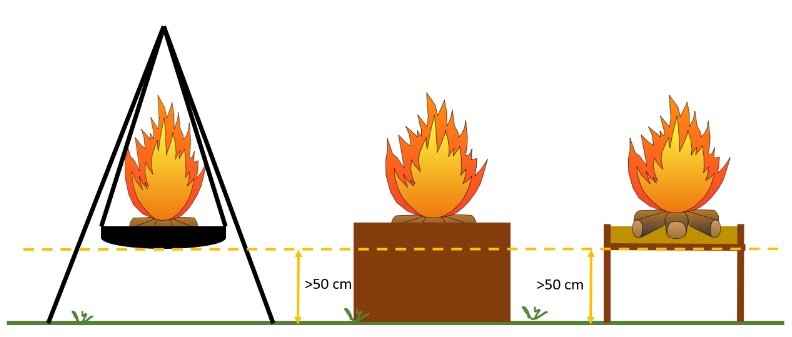
Cons: The fire surface is relatively small and swings freely, with the risk of firewood or glowing coals falling off. However, the positive thing is that you can keep the prescribed 500 mm between the ground and the bottom edge of the hearth.

The pot is difficult to get in and out between the fire tray’s suspension chains. A risky construction.

D. A bad construction

Construction: A fireplace pot is placed on stacked bricks to the required height. An iron tripod holds the pot up.

Cons: No constructions where the fireplace rests on stacked bricks will be approved. The construction is wobbly and there is a great risk that the stacked bricks will topple, causing glowing logs to fall to the ground. An unacceptable risk construction.

THE BASIC RULES FOR FIREPLACES, AND BY WHICH WE WILL JUDGE THEM, ARE AS FOLLOWS:
  • The bottom edge of the hearth is >500 mm above the ground.
  • The construction of the fireplace is stable and in no way at risk of tipping or wobbling.
  • Wood in the construction should generally be kept at least 200 mm from the fire, and wood that cannot be inspected should be insulated with sand and/or bricks, at a minimum 150 mm thick.
  • The hanging device for the pots should be stable in all directions, even if you pull on the pot. There is a considerable risk with boiling pots hanging about 70 cm above the ground. A pot filled with stew or water weighs a considerable amount, and introduces considerable forces into the construction, if it starts to sway or swing just a little.”Basic rules…” som börjar på sidan 6 och slutar på sidan sju, skska
  • There should always be a fire extinguisher (class ABC) in close proximity to the fire, although ”hidden”. Anyone above the age of 15 years old can be left attending the fire, but should always know the position and function of the fire extinguisher.
    Also keep a bucket of water close by, to extinguish stray embers etc. 

One last note. 

These constructions are not blueprints. Copying for example version B doesn’t automatically make your fire approved. Use common sense! We do not want a fire in the camp or anyone to be scalded by boiling water.